
A Novel Approach for Early Detection of Wildfires Using Power Line Crawlers with Embedded ML Image Classification

Abstract
Wildfires are one of the most dangerous natural disasters that strike California and the United States, destroying homes and forest resources. Early detection of wildfires has become invaluable in minimizing their destruction.
In this project, a power line crawler was developed for early detection of wildfires. The crawler would move along the power line, taking pictures and running a wildfire detection algorithm.
The crawler includes a camera to capture an image of the landscape, and embedded processors to run a Convolutional Neural Network (CNN) machine-learning model to detect wildfires. The crawler transmits the detection result, as well as its position, to a central database using a long-range, low-power radio transmitter.
The CNN model was trained using transfer learning, utilizing previously trained generic models that are fine-tuned with synthetic AI-generated landscape images with and without wildfires.
Multiple models were trained with different numbers of images, ranging from 200 to 1000. The accuracies ranged from 91% to 96%, increasing with more images. A prototype of the crawler was built using 3D-printed parts and off-the-shelf electronics. The CNN model was implemented on an ESP32-CAM processor board, which captures the image and runs the classification. The long-range communication is implemented using a LoRa radio transmitter.
The prototype and model performances show that a power line crawler with an embedded machine-learning model is a viable solution for this critical problem. This solution can be deployed by power companies and government organizations to quicken responses to wildfires, minimizing the damages that they can cause.
Crawler Robot

3D Printed Parts

Enclosure

Wheels and arms
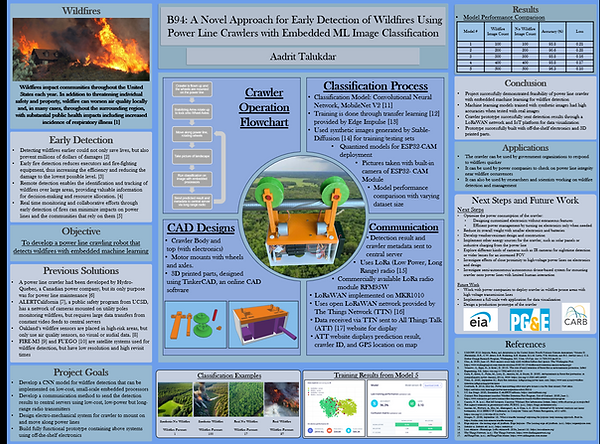
Science Fair Poster
AI Model Training Images

Real Image - No Fire

Real Image - With Fire
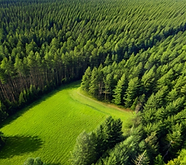
Synth Image - No Fire

Synth Image - With Fire